The 2021–2022 Drillbotics competition will require the contestants to integrate human factors engineering considerations into their automated drilling rigs for the first time.
2021-2022年Drillbotics竞赛将首次要求参赛者将人为因素和工程考虑融入他们的自动化钻机。
November 9, 2021
2021年11月9日
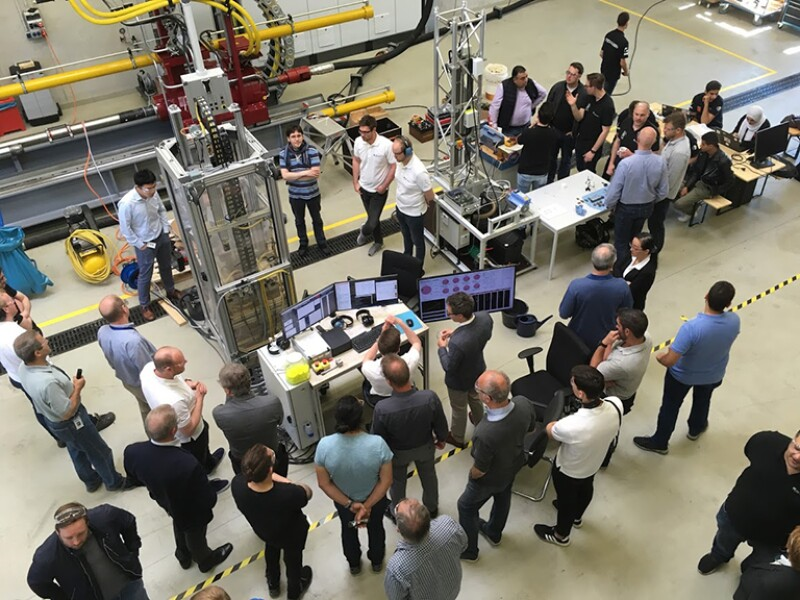
选手们在德国赛勒参加2019年Drillbotics大赛。
Drillbotics is an international competition for university students to design and build a small drilling rig that uses sensors and control algorithms to autonomously drill an unknown rock sample. Alternately, they may create a full-scale virtual rig. In either category, teams will be given downhole targets only on the day of the final test and must automatically plan the trajectory and drill a directional well as efficiently as possible.
Drillbotics是一项大学生设计和建造小型钻机的国际竞赛,该钻机使用传感器和控制算法来自主钻取未知岩石样本。或者,他们可以创建一个全尺寸的虚拟钻机。在这两类作业中,作业团队只能在最终测试当天获得井下目标,并且必须自动规划轨迹,尽可能高效地钻进定向井。
The collaboration between the SPE Human Factors and the SPE Drilling Systems Automation technical sections resulted in new requirements being added to the competition guidelines.
SPE人工因素和SPE钻井系统自动化技术部门之间的合作,为竞争指南增加了新的要求。
"Asking students to not only read about human factors but actually to integrate HF requirements into their designs is an important milestone for the drilling industry. When things go wrong on a rig, too often we see examples of the operator getting blamed for what HF practitioners may consider poor system design that leads to the equipment operator not having the needed information to diagnose a problem and intervene effectively,” said Marcin Nazaruk, chair of the SPE Human Factors Technical Section.
“要求学生不仅要了解人为因素,还要将HF要求融入到设计中,这是钻井行业的重要里程碑。举一个常见的例子,当钻机出故障时,因为HF操作者可能会考虑到导致设备不良的系统设计。操作员没有诊断问题和有效干预所需的信息,”SPE人为因素技术部门主席Marcin Nazaruk说。
Considering how people interact with automated systems has been high on the agenda for many years across the high-hazard industries, including aviation, nuclear, or healthcare, and is at the forefront of research when designing self-driving cars. Its recognition has also been growing in the oil and gas industry.
考虑人们如何与自动化系统交互多年来一直是高危险行业(包括航空、核能或医疗)的重要议程,在设计自动驾驶汽车时处于研究前沿。它在石油和天然气行业的影响力也在不断提高。
The concept that “machines” (automation) are better at some tasks than humans and vice versa has been prevalent for decades.
“机器”(自动化)在某些任务上比人类更好,反之亦然的概念已经流行了几十年。
Two examples:
两个例子如下:
·Humans surpass machines in respect to their ability to improvise and use flexible procedures.
·在即兴创作和使用灵活程序的能力方面,人类超过了机器。
·Machines surpass humans in respect to their ability to handle highly complex operations (i.e., do many different things at once).
·机器在处理高度复杂的操作(即同时做许多不同的事情)的能力方面超过了人类。
"It may appear that there are very few downsides to providing very high levels of automation with little to no required user input. However, there is no such thing as a 'free lunch,' and there are overlooked downsides to providing high levels of automation, usually termed the 'ironies of automation' which must be suitably managed," said Peter Gibson, human factors specialist of Human System Interactions Ltd., a supporter of the competition.
“在几乎不需要用户输入的情况下提供高水平的自动化似乎没有什么坏处。但是,没有所谓的‘免费午餐’,提供高水平的自动化也有被忽视的坏处,通常被称为‘自动化的讽刺’,必须进行适当的管理。”竞赛的支持者、人类系统交互有限公司的人类因素专家Peter Gibson说到。
Two examples of such ironies:
这类讽刺的两个例子:
·Any autonomous system is ultimately conceived and designed by humans. Attempts to design out the human merely shift the responsibility further up the chain. Operators involuntarily inherit the biases and performance shaping factors that influenced the design team.
·任何自治系统最终都是由人类构思和设计的。试图设计出人类,只会把责任进一步转移到链条的上游。操作员不自觉地继承了影响设计团队的偏见和性能形成因素。
·The autonomous system cannot account for unforeseeable scenarios. This is one of the predominant reasons humans remain part of complex systems, to address the “unknown unknowns.” However, expecting human operators to flip between a passive monitoring role and an active “doing” role is difficult to achieve. As a result, they may be out of the loop, and their situation awareness may be compromised.
·自治系统无法解释不可预见的情况。这是人类仍然是复杂系统一部分的主要原因之一,以解决“未知因素”。然而,期望人类操作员在被动监控角色和主动“做”角色之间转换是很难实现的。其结果是,他们可能处于循环之外,他们的态势感知可能会受到影响。
As part of the 2021–2022 Drillbotics guidelines, students will be asked to consider what information operators need and determine how to best present it so that the operator can always remain in the loop and effectively intervene if things do not go to plan.
作为2021至2022年Drillbotics竞赛指导方针的一部分,学生将被要求考虑信息操作员需要什么,并确定如何最好地呈现它,这样操作员就可以始终保持在循环中,并且如果事情不按计划进行,则有效干预。
The competition participants will also learn about:
参赛者还将了解以下几个方面:
·Levels of automation
·自动化水平
·The basics of human factors engineering and design
·人为因素工程与设计基础
·Alarm management and alarm philosophy
·预警管理和预警原理
·User-interface design
·用户界面设计
·Case studies in which automated systems contributed to problems
·自动化系统导致问题的案例研究
·Human factors in remote operations, and many others
·远程操作中的人为因素,以及许多其他因素
"We are introducing HF this year so that teams will get the basics of this science that is relatively new to our industry," said Fred Florence, president of Rig Operations and vice-chair of the competition’s leadership team.
“我们今年将引入高频技术,这样团队将获得这门科学的基础知识,这对我们的行业来说是相对较新的,”钻机运营总裁兼竞赛领导团队副主席Fred Florence说到。
To learn more about human factors in drilling automation, see Section 11 of the Drilling Systems Automation Roadmap Report on Human-Systems Integration or the 2020 SINTEF report on human-centered design in drilling and wells.
要了解更多有关钻井自动化中人为因素的信息,请参阅钻井系统自动化路线图报告中关于人与系统集成的第11节或2020 SINTEF报告中关于钻井和油井中以人为中心的设计。
总结:随着科技技术的发展进步,各行各业均向着自动化的方向发展,石油行业也不例外。本文通过Drillbotics竞赛规则的一项改动,体现出人与自动化系统交互的重要性。在设计钻机等器械时,不单单要考虑其自动化程度,也应当将人机交互的因素考虑进去,尽量使整个过程不会出现不当操作。
学术部 硕2020级5班 汪 策
外联部 硕2020级5班 陈虹昆