内容简介:
《蜀音西行——基于歌剧<杨升庵>的杨慎国际形象建构与传播》以现代歌剧《杨升庵》为主要媒介,以中国明代著名人物杨慎(号升庵)为研究对象,从历史生平、艺术再现、媒介表达、文化传播等多个维度系统探讨杨慎形象在国内外的建构逻辑与传播路径,并尤其关注其形象在国际舞台上的转化与接受过程。全书共六章,其中,译者负责本书第三章《历代杨慎形象建构与传播综述》的翻译,总计约1.5万字。这一章节既分析了杨慎在传统文献如正史、地方志、笔记中的形象呈现,也探讨了戏剧演绎、民间叙事以及当代媒体对其形象的再创与演变,全面呈现了该文化形象跨越历史与媒介的多重面貌。
译文修改:
例1:
ST: 针对“湖广土官水尽潦通塔平长官司进贡”这一记载,翰林院中的部分官员在理解时出现了偏差,他们错误地将“长官司”这一词组拆分成了三个独立的地名,因而在“长官司”之前误加了一个“三”字,导致对整个地名的解读产生了混淆。
TT1: Confronted with the record “Tribute from the Shuijinliao Tongtaping Chiefs Office of Huguang1,” some Hanlin Academy officials misinterpreted it, erroneously parsing this place name as three separate place names and thus wrongly adding a “san (three)” character before it, causing confusion over the entire geographic designation.
1Huguang(湖广): Huguang was a provincial-level administrative unit during the Ming dynasty, covering the areas of modern Hunan and Hubei provinces.
TT2: Confronted with the record “Tribute from the Shuijinliaotongtaping1 Chiefs Office of Huguang Region2,” some Hanlin Academy officials misinterpreted it, erroneously parsing this place name as three separate place names and thus wrongly adding a “san (three)” character before it, causing confusion over the entire geographic designation.
1Shuijinliaotongtaping (水尽潦通塔平): A six-character place name in Ming-era records, referring to the Shuijinliaotongtaping Chiefs Office. This was a local, hereditary chieftain commission subordinate to the Rongmei Pacification Commission. It was located in what is now the border area of Hefeng County and Wufeng Tujia Autonomous County in southwestern Hubei Province.
2Huguang Region (湖广): During the Ming dynasty, this term referred to a provincial-level administrative unit covering the areas of modern Hunan and Hubei provinces.
例2:
ST: 杨慎得知消息,心急如焚,当即披甲执戈,率领家中僮仆及步兵百余人,疾驰而往,誓要解张峨之困。
TT1: On hearing the news, Yang Shen was seized with urgent anxiety; donning armor and taking up his spear, he led more than a hundred household retainers and foot soldiers and rode at full speed to rescue Zhang E.
TT2: On hearing the news, Yang Shen was seized with urgent anxiety; donning armor and taking up his spear, he rode at full speed at the head of more than a hundred household retainers and foot soldiers to rescue Zhang E.
例3:
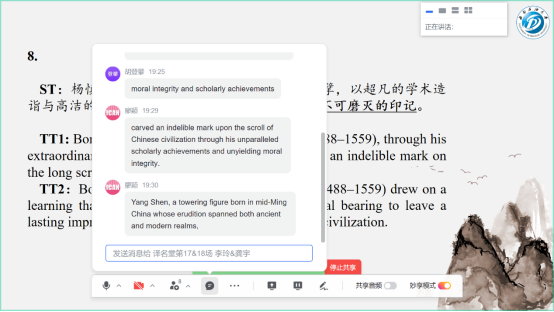
ST: 杨慎,这位生于明代中叶、学贯古今的巨擘,以超凡的学术造诣与高洁的人格风骨,在华夏文明长卷中镌刻下不可磨灭的印记。
TT1: Born in the mid-Ming period, Yang Shen (1488–1559), through his extraordinary erudition and moral integrity, engraved an indelible mark on the long scroll of Chinese civilization.
TT2: Yang Shen, a towering figure born in mid-Ming China whose erudition spanned both ancient and modern realms, carved an indelible mark upon the scroll of Chinese civilization through his unparalleled scholarly achievements and unyielding moral integrity.
研讨反思:
本次译名堂研讨围绕翻译实践材料中的一系列难点展开。
首先,需确保文化意象的准确转换,为相关表述寻找有据可依的参考译法。对文中出现的文化负载词,应积极查证平行文本与权威译法;对于四字格等中文特色表达,则可以先进行语义分类,再为各类表达寻找并确立恰当的翻译案例。
其次,应充分考虑译文的文学性、对仗美感以及目标语读者的接受度。为此,可以尝试借助AI工具,通过模拟不同文化背景的译者(如文学专家或外国读者)的视角,来试译文中的对仗句与诗歌,以拓宽翻译思路。同时,需进一步优化并整理中英诗歌的格式与结构,参考权威的英文诗歌范式。
最后,应建立并遵循统一的翻译规范,以保证全文的一致性。例如,文中专有名词若使用脚注进行解释,其格式需统一;对于复杂地名,可尝试建立地名类术语库,以系统化管理其译法。